
The Best Higaeri Onsens in Tokyo (Including Kanagawa & Saitama)
When I get asked where to go for a great onsen without an overnight booking, I hear all the same assumptions every time. “There’s no Higaeri Onsens in Tokyo!” “You need to get a train to Hakone!” Naturally, they are left surprised when I tell them that some of the best higaeri (day-trip) onsens in Tokyo are 20 minutes from Shinjuku.
The truth is, the Tokyo day-trip onsen scene is in better shape than the English-language internet tends to suggest. Most guides still link to facilities that closed years ago, ignore Kanagawa and Saitama entirely despite them being entirely accessible, and send everyone to Hakone Yuryo (Hakone Yuryo is great though!)
So here you can find my honest list of ten facilities I’d genuinely send someone to, all confirmed open in 2026.
Quick Choices
If you want the most foreigner-friendly central Tokyo option, choose Thermae-yu Shinjuku — it’s open 24 hours, it’s a 5-minute walk from Shinjuku Station, and the tattoo policy works for visitors with passports. For the most photogenic experience, Manyo Club Yokohama has the rooftop foot bath looking across the Bay Bridge. And if you want a genuine natural hot spring inside the 23 wards, Maenohara Sayano Yudokoro in Itabashi is the only place I’d send you for that.
The box above is just a quick snapshot, so find the full list is below, including the picks in Kanagawa and Saitama that I think are worth the slightly longer trip.
What “Higaeri” Actually Means
I’d just like to quickly make sure we’re on the same page about what “Higaeri” means.
If higaeri is a new word to you, the literal translation is “day return”. It’s the umbrella term for visiting any onsen or bathing facility without staying overnight. A higaeri onsen, then, is a place set up specifically for that. You walk in, pay an entry fee, soak for a few hours, and walk back out. No room booking, no kaiseki multi-course dinner, no 10am checkout. It’s not a hotel.
It’s worth knowing how this is different from the below categories that will crop up as buzzwords throughout the list:
The facilities I will introduce below actually sit in between. Most are large purpose-built “super-sento” complexes that pipe up actual hot spring water, charge ¥500–¥3,000 for entry, and let you linger as long as opening hours allow. A few are smaller neighborhood bathhouses that quietly happen to have real onsen water underneath.
The Best Higaeri Onsens in Tokyo
Maenohara Sayano Yudokoro (Itabashi, Tokyo)
I think Sayano Yudokoro is probably one of the most impressive onsens I’ve seen inside the Tokyo 23 wards, and you’ll understand why once you see the Japanese garden.
It sits in a quiet residential corner of Itabashi, around 8 minutes from Shimura-Sakaue Station. From the outside it’s unremarkable. Even more so, the entrance doesn’t really give anything away about what awaits: and then you’ll happen across an unbelievably quiet wisteria garden, a koi pond, and a farmhouse-style main building that feels much further from the city than it actually is.
Just the garden is enough to put Sayano Yudokoro on the list, but even more impressive is that it is the only facility in central Tokyo officially claiming 100% gensen kakenagashi, meaning the spring water runs straight from the source into the bath with nothing added and nothing recycled. It comes out a pale yellow-green that the Japanese call uguisu, and it genuinely feels different on your skin. If you’re staying for a meal, you can also book one of the private cottage baths for a couple of hours, which is one of the best-value private onsen experiences in the city. The restaurant is cushions on the floor tatami-style, which is actually quite difficult for a regular first-time Japan visitor to find, so I really recommend it.
Sakura-kan (Ota, Tokyo)
For ¥550, Sakura-kan is undoubtedly the best value facility on this list. It’s not an unusual price for a sento, which is essentially what Sakura-kan is, but it has more than a few secrets which make it feel like criminal undercharging.
It’s been running as a neighbourhood bathhouse since 1959, in the temple district of Ikegami Honmonji, a short walk from Ikegami Station on the Tokyu line. The building has the kind of quiet, lived-in character that no chain super-sento will ever manage to fake. The tiny reception and the neighborhood hospitality really give it the life and personality that keeps people coming back.
The water is kuro-yu, a deep sodium bicarbonate “black water” so dark you genuinely can’t see your hand once it’s submerged. It’s the same basic spring chemistry as the much fancier facilities down at Miyamaedaira and Tsunashima, but here you get it for less than the price of a coffee. There’s also a semi-monthly gender rotation between the two bathrooms, and one of them includes a rare rooftop observation bath, so it’s worth checking which side you’re on before you go.
Yukemuri no Sho Miyamaedaira (Kawasaki, Kanagawa)
A 30-minute ride from Shibuya gets you to one of the deepest-coloured kuro-yu onsens around the capital, at one of the best prices.
Miyamaedaira is accessible by train from Shibuya for about ¥250, because the Den-en-toshi Line runs direct. The bath is a couple of minutes from the station exit. It’s about as easy a day trip as you can do from central Tokyo while still arriving at a genuinely good facility.
The water is drawn from 1,500m underground and comes out brown-black, in the same bijin no yu skin-smoothing chemistry as Tsunashima further south. The facility itself is the standard Yukemuri group setup — clean, modern, and comfortable, with a large ganban section and a lounge where towels and lounge wear are included in the entry price. Nothing flashy. Just a solid black-water onsen on a budget.
Yukai Soukai Taya (Yokohama, Kanagawa)
Taya isn’t the easiest facility on this list to reach, but if you’re already heading down towards Kamakura or Enoshima, it’s a brilliant final stop on the way back.
It sits in the southern suburbs of Yokohama, about ten minutes by bus from JR Ofuna Station. The bus is the slight inconvenience, but Ofuna is on the same line you’d already be taking for the Kamakura day trip, so it slots in naturally as the relaxing end of a sightseeing afternoon.
The water is sodium bicarbonate — the bijin no yu black water again — paired with a separate medical-grade carbonated spring that genuinely tingles when you sit in it. The standout feature is the outdoor “wild sky” bath, set into a small woodland clearing that feels about three hours further from Yokohama than it actually is. The on-site restaurant is also a notch above your average super-sento, which is worth knowing if you want to make an evening of it.
Manyo Club Yokohama Minatomirai (Yokohama, Kanagawa)
Most lists of higaeri onsens around Tokyo will put Manyo Club somewhere near the top, and for once, the consensus is actually right.
It sits in the middle of Yokohama’s Minato Mirai 21 district, walkable from the Minatomirai station and reachable on a free shuttle from JR Yokohama. If you’re spending the day on Yokohama Chinatown, the Cup Noodles Museum or the Red Brick Warehouse, it’s the natural endpoint to a sightseeing day.
The water here is trucked in by tanker from Atami and Yugawara every day in the old okumi-yu tradition, meaning it’s real natural hot spring water, just delivered from the source instead of pumped up from underneath the building.
The signature spot is the 9th-floor open-air foot bath garden, which on a clear evening looks across the Yokohama Bay Bridge and the Minato Mirai skyline. It’s the one shot most visitors end up taking home.
Ryusenji no Yu, Soka Yatsuka (Soka, Saitama)
I’ll be honest — I went back and forth on whether a Saitama facility had a place on a “best higaeri onsen in Tokyo” list. Then I remembered the sauna setup, and Ryusenji Soka went straight back on.
You might ask me what on earth I was doing in Soka in the first place. Soka has a great festival in the summer, so a soak after hours in the heat was just what I needed.
In terms of this facility as a “higaeri” facility: it’s roughly 50 minutes door-to-door from Akihabara on the Hibiya Line to Soka Station, and a free shuttle bus runs from the station out to the facility. So while it’s technically Saitama, the access is much more reasonable than the address suggests.
The headline is the “Bazooka Sauna”, a five-tier wooden tower with auto-löyly every half hour, plus a separate outdoor meditation sauna with self-löyly.
The water is also legitimately good (a sodium-chloride amber-gold spring with a faint salt taste), but honestly, the sauna is the reason you’d come. Dedicated sauna clubs in central Tokyo charge two or three times the price for a setup that doesn’t come close.
Thermae-yu (Shinjuku Kabukicho, Tokyo)
Thermae-yu has quietly become my default answer when someone asks for a late-night higaeri onsen in central Tokyo, and not just because of the Shinjuku location.
Of course it’s great for tourists. People gather in droves to look at the famous godzilla in Kabukicho, and after wrestling your way through the adjacent Don Quixote and mobs of strangely-dressed women on the street, it’s the best place to relax in this area.
Personally, after a long Shinjuku evening, I find walking into the lobby strangely calming.
The water is trucked in daily from Naka-Izu, a deep alkaline spring water that leaves your skin noticeably soft. There’s an indoor bath area, an outdoor rotenburo called Jindai no Yu, and themed baths that rotate weekly.
The real reason this entry exists, though, is the tattoo policy. Foreign male tourists with a passport can enter with a cover seal, and women can use up to four cover seals regardless of nationality. It’s one of the very few central Tokyo onsens where foreign visitors with tattoos can actually get in the bath legitimately.
Spadium Japon (Higashikurume, Tokyo)
Spadium Japon is one of the largest onsen complexes in the Tokyo area, and it costs less than your average super sento.
Higashikurume isn’t on most foreign visitor maps, which is part of the appeal. If you weren’t going to Spadium Japon, you’d never go here, which means that you get to see a quieter, more suburban side to Tokyo.
The facility itself is genuinely huge: 13 different baths, two large saunas, the biggest ganban setup in Kanto (and possibly Japan), a food court, two cafés, a restaurant, and a relaxation lounge with 30,000 manga to read between baths. All of that for under ¥1,000 entry. The free shuttle from Tanashi Station on the Seibu Shinjuku Line makes it about 30 minutes from Shinjuku.
The water is a sodium-chloride and bicarbonate spring drawn from 1,500m underground, classified as one of Japan’s bijin no yu “beauty waters”. Honestly, the scale is what makes Spadium Japon special. You can, and should, literally spend an entire day here. If it rains on you during your trip to Japan? This should be one of your first ports of call. Nothing wrong with a rainy onsen.
Ofuro no Ousama Oimachi (Shinagawa, Tokyo)
If you’ve got an awkward gap in your itinerary near Shinagawa, or you need an onsen at 4am, this is one of the few facilities in central Tokyo that solves both problems.
A quick word of warning: a lot of English guides will still point you to the Hanakoganei branch, but that one closed for renovation in April 2026 and won’t reopen until later in the year. It’s a shame, because I’ve been to that one too and I really would’ve liked to recommend it here. The Oimachi branch, inside the Hankyu Oimachi Garden complex, is the active option, and is honestly the easier one for visitors anyway.
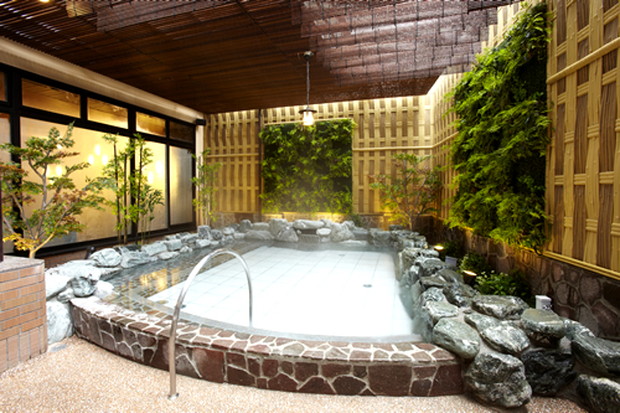
The access is really good: get off the train at JR Oimachi and walk through the mall for two or three minutes, and you’re at the towel desk. The facility itself is open from 9:30 AM until 8:30 AM the next morning, so it’s one of the only places in central Tokyo where you can genuinely bathe in the middle of the night. The towel set is included in the entry price, which makes it the obvious “I’ve packed absolutely nothing and just need to get in the onsen, pronto” choice.
Tsunashima Gensen Yukemuri no Sho (Yokohama, Kanagawa)
The old, famous Tsunashima Radium Onsen closed years ago. The active facility today is Tsunashima Gensen Yukemuri no Sho, and access genuinely improved when the Shin-Tsunashima Station opened in 2023 with direct trains to Shibuya.
It’s run by the same Yukemuri group as Miyamaedaira above, which means a similar build and a similar feel, but Tsunashima’s water is the darker of the two, and the sauna setup is much more ambitious, which is why I wanted to introduce it.
The water is the same sodium bicarbonate kuro-yu as Miyamaedaira and Sakura-kan, but Tsunashima’s is the deepest in colour, almost coffee-black. They also pour the black spring water into the cold bath, which is genuinely unusual and excellent.
The sauna stack runs three simultaneous löyly services across three different sauna rooms. They claim it’s the most in Kanto, and I haven’t yet found many comparable facilities to argue against the claim. It’s the one I’d send someone to if they wanted a strong all-rounder day trip without optimising for any single thing.
Final Thoughts: Picking the Right Higaeri Onsen for You
So that’s the ten I’d send people to. There’s a lot of overlap between them, so here’s my shortcut: three top picks, depending on the kind of day you want.
If you want the most convenient central Tokyo bath, choose Thermae-yu Shinjuku. It’s the easiest answer to most “I have an evening free, where do I go” questions, and the only central facility with a workable tattoo policy for foreign visitors.
If you want a genuine natural hot spring inside the 23 wards, choose Maenohara Sayano Yudokoro. It’s the only verified 100% gensen kakenagashi onsen in central Tokyo, and the garden is genuinely worth a look.
If you want the most memorable day out, and don’t mind a short hop into Yokohama, choose Manyo Club Minatomirai. The rooftop foot bath with the Bay Bridge view is probably the best photograph you’ll take from a Tokyo higaeri onsen. You can spend hours here.
No matter which one you go for, you’ll have no regrets.
Any Questions or Feedback?
If you’d like a personal recommendation based on your dates, where you’re staying, or any tattoo-specific questions, head to the Get Advice page and I’ll get back to you personally.
Or, if you’d like to keep browsing, head to the full day-trip onsens page for more around the country.
Enjoy your soak!